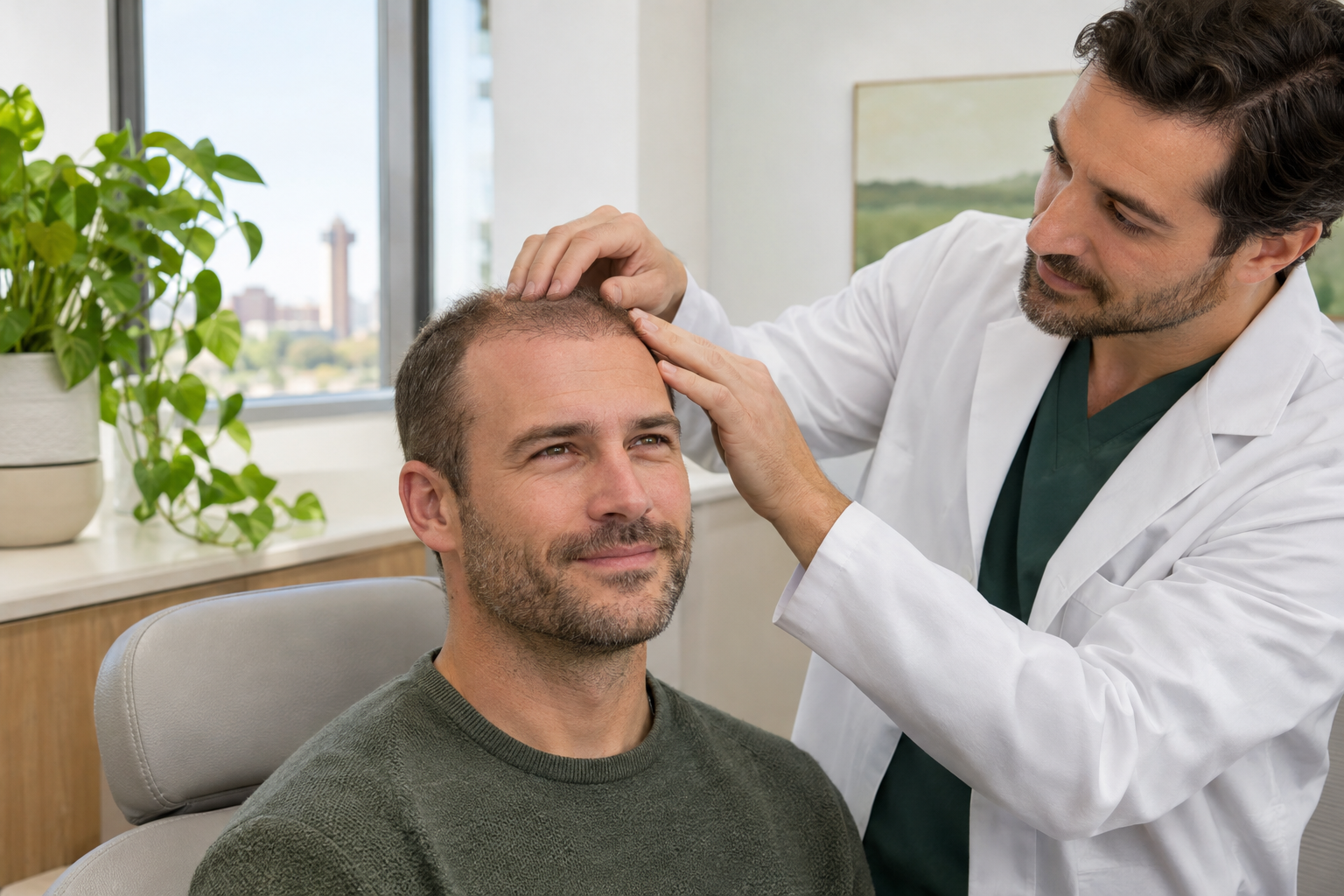
A hair transplant recovery timeline usually includes several days of visible healing, a shedding phase during the first two months, early regrowth after a few months, and gradual maturation over roughly a year. At our Fort Worth clinic, we explain that recovery is not one identical schedule for every patient. Your procedure type, graft count, donor area, scalp characteristics, medical history, and individual healing response all influence what you experience.
This week-by-week guide can help you understand the usual stages, but it does not replace the instructions we give you after surgery. Washing methods, medications, sleep position, exercise, sun exposure, hats, haircuts, and return-to-work timing can differ between patients and surgeons. Always follow your own written aftercare plan and contact our clinical team if something does not seem right.
Hair Transplant Recovery at a Glance
- First week: Tenderness, redness, swelling, crusting, and donor-area discomfort may occur while the small wounds begin healing.
- Second week: Crusts commonly resolve, and the treated areas often become less noticeable.
- Weeks 2-8: Many transplanted hair shafts shed. Some native hairs may also shed temporarily.
- Months 2-4: The scalp can look similar to, or temporarily thinner than, it did before surgery. Early new growth may begin.
- Months 5-9: More visible growth and coverage often develop.
- Months 10-12 and beyond: Hair may continue to mature in length, caliber, texture, and overall appearance.
The American Academy of Dermatology’s hair transplant guidance notes that transplanted hairs commonly shed between two and eight weeks, that many patients see results between six and nine months, and that some need 12 months. The International Society of Hair Restoration Surgery also emphasizes that postoperative routines vary by surgeon, which is why our instructions for you should take priority over a general online calendar.
Procedure Day: Protect the Grafts and Follow Your Discharge Plan
After your procedure, our team will review how to care for the donor and recipient areas, how to use any prescribed or recommended medication, and what activities to avoid. You may leave with a dressing on the donor region, depending on the procedure and our plan for you. The recipient area may look pink or red, with tiny graft sites that are visible at close range.
Local anesthesia can leave the scalp numb for a period of time. As sensation returns, mild soreness, tightness, tingling, or sensitivity may develop. We may advise you to keep your head elevated when resting, avoid touching or rubbing the grafts, and arrange transportation because procedure-day medications can affect your ability to drive safely.
What we want you to remember on day zero
- Do not scratch, pick, or press on the recipient area.
- Use only the cleansing method and products we recommend.
- Take medications only as directed and tell us about unexpected reactions.
- Avoid alcohol, smoking, exercise, and other restricted activities for the period specified in your plan.
- Know how to reach us if you have questions after leaving the clinic.
Day 1: The First Follow-Up Window
During the first 24 hours, the recipient sites are especially vulnerable to rubbing or accidental impact. Mild spotting, tightness, tenderness, and numbness can occur. Some patients begin to notice swelling near the forehead, which may shift downward before resolving.
We may arrange an early follow-up or provide a detailed remote check-in plan. If washing begins on day one, use only the technique we have demonstrated. Do not improvise with high water pressure, vigorous massage, ordinary styling products, or a towel rubbed across the grafts.
Days 2-3: Swelling and Tenderness May Peak
For some patients, swelling is most noticeable during this stage. Redness, small crusts, tightness, and mild discomfort may still be present. The donor area can feel different depending on how we harvested the grafts.
With follicular unit excision or extraction (FUE), individual follicular units are removed through small circular openings. The donor region may look dotted, feel tender, and develop tiny scabs. With FUT, the donor incision may feel tight and requires care around the closure. Neither technique is scar-free.
Continue the prescribed cleansing routine and protect the scalp from friction. Before wearing any hat or head covering, confirm when and what type we allow. A covering that presses or drags across fresh grafts can disrupt the recipient area.
Days 4-7: Crusts and Redness Begin to Settle
The small crusts around grafts often become more noticeable before they loosen. Redness and swelling usually start improving, although people with lighter skin tones or sensitive scalps may notice discoloration longer. Itching can occur as wounds heal, but scratching can injure the skin and grafts.
Many patients feel comfortable doing quiet desk work during this period, but visible healing, job demands, and the ability to protect the scalp affect return-to-work timing. If your work is strenuous, outdoors, dusty, hot, or requires a helmet, you may need a different plan. Ask us before resuming activities that could cause sweating, impact, contamination, or sun exposure.
Week 2: Scabs Resolve and the Scalp Looks More Normal
By the end of the second week, many small crusts have flaked away and the transplanted area is less obvious. The International Society of Hair Restoration Surgery describes FUE scabs as commonly resolving within about one to two weeks, while noting that individual surgeons use different care protocols.
Do not force crusts off ahead of our schedule. If buildup remains, we can advise whether the cleansing technique should change. After FUT, sutures or staples may still need evaluation or removal according to the closure method and our instructions. The linear donor incision should not be stretched or stressed prematurely.
At this point, some transplanted hairs may already begin shedding. That can feel discouraging, but loss of the visible hair shaft does not automatically mean the follicle is gone.
Weeks 3-4: Shedding Is Expected
During weeks three and four, transplanted hairs commonly enter a resting stage and shed. The recipient area can look similar to its preoperative appearance. Some nearby native hairs may also shed after the physical stress of surgery, a temporary response often called shock loss or telogen effluvium.
Shedding varies widely. You may lose many visible transplanted hairs, only some, or notice the change gradually. We encourage you to judge progress with standardized photographs and scheduled follow-ups rather than daily mirror checks.
Weeks 5-8: The Quiet or Resting Phase
By one to two months, the surface of the scalp may look healed even though the follicles remain in a biologic resting phase. The American Academy of Dermatology reports that shedding between two and eight weeks is normal and that the hair can appear thinner by the third month.
This phase is usually more about patience than visible change. Continue any scalp care or hair-loss management that we have approved. Do not begin, stop, or change prescription treatment solely because of a generic online timeline; medication decisions should reflect your diagnosis, medical history, and our clinical guidance.
Months 2-3: Early Sprouts May Appear
Some patients notice fine, colorless, uneven, or slow-growing hairs during the second or third month. Others see little visible change yet. Early hairs may not resemble the final result because they can be thin and immature.
Temporary pimples or small cyst-like bumps can sometimes appear as hairs begin emerging. Do not squeeze or pick them. Contact us so we can determine whether simple care is appropriate or whether the area needs an examination.
Month 4: Growth Becomes Easier to Track
By month four, more new hairs may become visible, but density is still developing. Growth can be uneven across the scalp, and different treatment areas may mature at different speeds. Hairline, mid-scalp, and crown restoration do not always look complete on the same schedule.
Our team uses follow-up photographs to compare consistent angles, lighting, hair length, and styling. This provides a fairer assessment than comparing one close-up image with a differently lit photograph.
Months 5-6: Noticeable Growth Often Begins
Many patients see a more meaningful change by months five or six. New hairs may still be fine, short, and variable in texture. The appearance can continue improving as more follicles grow and individual shafts become thicker.
If your procedure used follicular unit transplantation (FUT), we will also monitor the linear donor scar and discuss appropriate scar care. FUT removes a donor strip that is divided into follicular-unit grafts. FUE harvests individual units and leaves many small circular scars instead. The recipient-area growth cycle is similar because both techniques ultimately place follicular-unit grafts into thinning areas.
Months 7-9: Increasing Coverage and Maturation
Between months seven and nine, growth is often easier to see in everyday lighting and photographs. Hair length increases, more shafts may emerge, and coverage can improve. According to the American Academy of Dermatology, many patients see results during this interval.
Results remain individual. Donor-hair characteristics, graft survival, treatment area, scalp-to-hair color contrast, curl, caliber, continued loss of native hair, and styling all influence the visual effect. We avoid promising a specific density or identical timeline for every patient.
Months 10-12: A More Complete Result Takes Shape
By about one year, many patients can make a more meaningful assessment of the transplant. Hair may continue to thicken, soften, lengthen, and settle into its natural direction. Some areas, especially the crown, may mature more slowly.
A one-year review can help us assess growth, the donor area, the surrounding native hair, and whether any future treatment should be considered. Continued thinning outside the transplanted area can change the overall appearance even when transplanted follicles are growing.
Beyond 12 Months: Long-Term Follow-Up
Some improvement can continue beyond the first year. Long-term planning may include monitoring native-hair loss, discussing medically appropriate maintenance, and preserving donor supply. A second procedure is not automatically necessary and should be based on remaining donor hair, evolving loss, scalp health, and realistic goals.
You can review information about Dr. Stefan P. Thiele and our hair-restoration approach as you consider who will guide your procedure and follow-up care.
FUE vs. FUT Recovery: What Is Different?
| Recovery factor | FUE | FUT |
|---|---|---|
| Donor wounds | Many small circular extraction sites | One linear donor incision closed with sutures or staples |
| Scarring | Small distributed scars; not scar-free | Linear scar that may be concealed by surrounding hair |
| Early discomfort | Often described as less uncomfortable, but experiences vary | Donor tightness and incision tenderness may be more noticeable |
| Donor aftercare | Care for multiple small extraction sites | Protect the closure and follow removal instructions if applicable |
| Recipient growth | Both methods place grafts in recipient sites, so shedding and gradual regrowth follow broadly similar biologic stages. | |
The technique that fits you depends on donor characteristics, graft needs, prior surgery, hairstyle preferences, scarring considerations, medical history, and long-term goals. We do not present either method as universally better.
When to Contact Our Clinical Team
We want you to contact us whenever you are unsure about your recovery. Seek prompt medical advice for symptoms such as:
- Bleeding that is heavy, persistent, or not controlled as instructed
- Severe or worsening pain rather than gradual improvement
- Fever, chills, pus, foul drainage, or spreading redness
- Rapidly increasing swelling, breathing difficulty, hives, or signs of an allergic reaction
- Wound separation or a problem with FUT sutures or staples
- Darkening skin, concerning tissue changes, or trauma to the grafts
- Any symptom that feels urgent or substantially different from the plan we discussed
If you believe you are experiencing a medical emergency, seek emergency care rather than waiting for an online reply.
Frequently Asked Questions
How long should I take off work after a hair transplant?
Time away depends on visible healing, your comfort, procedure type, and job demands. Quiet desk work may be possible sooner than strenuous, outdoor, dusty, hot, or helmeted work. We will give you an individualized recommendation.
When can I wash my hair normally?
We will show you how and when to clean the donor and recipient areas. Early washing is usually gentle and avoids rubbing or strong water pressure. Do not switch to your normal routine until we tell you the grafts and wounds are ready.
Is shedding after a hair transplant normal?
Yes. Many transplanted hair shafts shed between two and eight weeks. Nearby native hairs can also shed temporarily. Contact us if shedding is accompanied by inflammation, severe symptoms, or another concern.
When will I see my final hair transplant results?
Many patients notice visible growth between six and nine months, while fuller maturation may take 12 months or longer. Treatment area and individual healing affect the timeline.
Can I speed up hair transplant recovery?
There is no responsible shortcut. Protect the grafts, follow our cleansing and activity instructions, take only approved medications, attend follow-ups, avoid tobacco, and give the follicles time to cycle naturally.
Plan Your Recovery With Our Fort Worth Team
A successful recovery is built on realistic expectations, careful aftercare, and easy access to the team managing your procedure. Before surgery, we review the technique, donor and recipient care, time away from normal activities, likely shedding, growth milestones, potential complications, and how to reach us with questions.
If you are considering treatment in Fort Worth or elsewhere in North Texas, request a hair transplant consultation with our team. We can evaluate your hair-loss pattern and donor area, discuss FUE and FUT, and explain the recovery plan that would apply to your circumstances.
This article provides general education and does not replace your surgeon’s instructions, diagnosis, or individualized medical advice.