
Hair Transplant for Crown: Restoring Thinning at the Back of the Head

A hair transplant for crown thinning can move healthy follicular units from a suitable donor area into the circular region at the back of the scalp. At our Fort Worth clinic, we plan crown restoration around your hair-loss diagnosis, the size and shape of the thinning area, available donor hair, the natural whorl pattern, and the possibility that surrounding hair may continue to thin. The goal is not to promise a fixed number of grafts or a perfectly dense crown. It is to determine whether surgery is appropriate and, when it is, create a realistic plan that uses a limited donor supply responsibly.

The crown is also called the vertex. It can be one of the most demanding areas to restore because hair changes direction around a central whorl, the scalp is viewed under overhead light, and a broad area may require many grafts to create visible coverage. We evaluate the crown as part of the entire scalp rather than treating one bald spot in isolation.

Why Crown Hair Restoration Requires Careful Planning

Crown hair does not grow in one straight direction. It commonly radiates or spirals around one or more whorls. Research on recipient-site design notes that the vertex can be complicated because transplanted hairs need to follow this pattern. If grafts are placed at inconsistent angles or directions, the result may look unnatural even when the follicles grow.

The crown can also consume a substantial share of the donor reserve. A larger circle requires more follicular units than a smaller area at the same planned density. Because donor hair is finite, we consider whether the front and mid-scalp need treatment now or may need it later. Prioritizing one area too aggressively can limit future options if hair loss progresses.

Visible coverage depends on more than a graft count. Hair shaft caliber, curl, color contrast between hair and scalp, the number of hairs in each follicular unit, crown size, existing miniaturized hair, styling, and lighting all affect how full the area appears. This is why two patients with similar-looking crown thinning may receive different recommendations.

Who May Be a Candidate for a Crown Hair Transplant?

A consultation is necessary to determine candidacy. In general, we look for a clear diagnosis, a usable donor area, realistic expectations, and a pattern that can be treated without compromising long-term planning. The American Academy of Dermatology explains that a candidate needs enough healthy scalp hair to transplant and the ability to grow hair in the thinning area.

During an assessment, we may consider:

  • The cause and pattern of your crown thinning
  • Your age and whether the loss appears stable or is still expanding
  • Density, caliber, and distribution of hair in the donor region
  • The diameter and shape of the crown area
  • Existing hair in and around the whorl
  • Previous surgery, scars, scalp conditions, and medical history
  • Your goals, hairstyle, tolerance for scarring, and future treatment priorities

Not every bald spot should be transplanted immediately. Crown thinning can expand over time, particularly in younger patients or people with active androgenetic alopecia. Surgery placed inside an evolving area may later be surrounded by additional loss. We may discuss observation, medical evaluation, or non-surgical management before surgery when that approach better protects your long-term options.

First Confirm the Cause of Crown Thinning

Pattern hair loss commonly affects the crown, but it is not the only possible cause. A scalp examination helps distinguish androgenetic alopecia from diffuse shedding, inflammatory or scarring disorders, alopecia areata, medication-related changes, nutritional problems, and other conditions. Some patients may need further medical evaluation before cosmetic surgery is considered.

We also look at the rest of the scalp. A crown-focused plan should account for the hairline and mid-scalp because these areas compete for the same donor supply. If you are also concerned about frontal recession, our guide to hair transplant options for a receding hairline explains how the priorities differ.

How Many Crown Transplant Grafts Are Needed?

There is no responsible universal graft number for crown restoration. An estimate depends on the measured surface area, existing hair, desired cosmetic coverage, donor characteristics, hair-to-scalp contrast, whorl complexity, and the density that can be placed safely. A quote based only on a photograph or a generic online chart can miss important clinical factors.

Transplantation redistributes follicles; it does not create an unlimited new supply. Our planning therefore balances current improvement with preservation of donor hair for the future. In a large crown, strategic coverage may be more appropriate than attempting to reproduce natural juvenile density. We explain what is feasible before you decide whether the tradeoff fits your goals.

FUE vs. FUT for Crown Hair Restoration

Both major harvesting methods can provide follicular-unit grafts for crown placement. The difference is how the grafts are obtained from the donor area, not whether the crown can form a whorl.

Follicular Unit Extraction or Excision (FUE)

With FUE hair restoration, follicular units are removed individually through small circular openings. This avoids one linear donor incision, but it is not scar-free. The number and distribution of extractions must be planned to reduce the risk of a visibly thinned donor area. FUE may appeal to people who prefer shorter hairstyles, though candidacy depends on donor density, scalp and hair characteristics, graft needs, and prior procedures.

Follicular Unit Transplantation (FUT)

With FUT hair transplantation, a strip of donor scalp is removed and divided into follicular-unit grafts. FUT leaves a linear donor scar and requires care around the closure. In suitable patients, it may provide a substantial number of grafts while preserving donor areas for possible future planning.

Neither method is automatically best for every crown. We compare expected graft needs, donor anatomy, scarring preferences, hairstyle, recovery, previous surgery, and future loss. The harvesting technique is only one part of the result; graft handling, site creation, placement direction, and long-term design also matter.

Designing a Natural Crown Whorl

Before placement, the treatment area and whorl are mapped. Recipient sites should follow the direction and angle of nearby hair, rotating around the center rather than forming rows. The pattern may be clockwise, counterclockwise, or more complex. Existing hair can guide the design when it is strong enough to preserve.

Density is planned as a visual strategy, not a promise to match the original scalp hair for hair. A crown whorl naturally exposes some scalp because hairs separate as they radiate outward. We consider how layering, hair caliber, curl, and color contrast can create coverage while using grafts conservatively. The plan should also avoid damaging existing follicles and should respect the blood supply of the recipient skin.

What Happens During the Procedure?

The exact sequence depends on the chosen technique and your individualized plan. In general, the donor and recipient areas are prepared, local anesthesia is used, follicular-unit grafts are harvested, and recipient sites are created to reproduce the crown’s changing directions. The grafts are then placed into those sites with attention to depth, angle, spacing, and handling.

Procedure time varies with the number of grafts and technique. Some plans may require more than one session, especially when the treatment area is large or when donor conservation is a priority. We review preparation, medications, transportation, washing, activity limits, and follow-up instructions with you before surgery.

Crown Hair Transplant Recovery and Growth

Early healing can include redness, tenderness, swelling, crusting, itching, and temporary numbness. You need to protect the grafts from rubbing, pressure, picking, and unapproved products while following your own postoperative instructions. Recovery varies, so a general online schedule should never replace the plan from your surgical team.

Transplanted hair shafts commonly shed during the first several weeks. This expected shedding does not necessarily mean the follicles were lost. New growth develops gradually, and the crown may mature more slowly than some frontal areas. Many patients need months before changes become visible and about a year, sometimes longer, before a more complete assessment is possible. Our detailed hair transplant recovery timeline describes the usual stages and warning signs.

Results, Limitations, and Continued Hair Loss

A crown transplant can improve the appearance of thinning in an appropriate candidate, but results vary. Graft growth, hair characteristics, the size of the area, progressive loss, healing, and adherence to aftercare all influence the outcome. No ethical plan can guarantee a specific density, exact graft survival rate, or identical result for every patient.

Non-transplanted hair around the grafts may continue to thin. That can enlarge the crown or create a difference between treated and untreated areas. We may discuss medically appropriate options for ongoing hair-loss management, but medications have risks and are not suitable for everyone. Decisions about treatment should follow an examination and review of your health history.

Possible complications include bleeding, infection, swelling, altered sensation, scarring, poor growth, folliculitis, temporary shedding of nearby hair, uneven density, an unnatural direction, donor-area thinning, and dissatisfaction with coverage. We discuss relevant risks, alternatives, and the possibility of future procedures during informed consent.

Frequently Asked Questions

Can a hair transplant fill a completely bald crown?

It may be possible to add coverage when donor supply and scalp health are suitable, but a large completely bald crown can require many grafts. The front and mid-scalp, future loss, and realistic cosmetic density should be considered before allocating donor hair.

Is crown hair restoration different from a hairline transplant?

Yes. Hairline work focuses on a soft frontal transition and facial framing. Crown work follows a circular whorl and often covers a broader area. Both require natural angle, direction, donor management, and long-term planning.

Does the crown need more grafts than the front?

Sometimes, but not always. A broad crown can use many grafts, while a small area with existing hair may require fewer. Surface area, hair caliber, follicular-unit composition, contrast, and planned density matter more than the label alone.

Will transplanted crown hair look completely dense?

Not necessarily. Hair transplantation aims for cosmetic coverage using a limited donor supply. The whorl naturally separates hair and can reveal scalp under bright overhead light. We discuss the likely visual improvement rather than promising original density.

Can crown thinning continue after a transplant?

Yes. Transplanted follicles and nearby native hairs do not necessarily follow the same course. Untreated hair can continue thinning, so the plan should account for future change and appropriate follow-up.

Discuss Crown Hair Restoration With Our Fort Worth Team

The most useful next step is an individualized assessment of your diagnosis, crown pattern, donor area, existing hair, medical history, and long-term priorities. You can learn more about Dr. Stefan P. Thiele and our surgical approach before meeting with us.

If you are considering a hair transplant for a bald spot or thinning crown in Fort Worth or elsewhere in North Texas, request a hair transplant consultation with our team. We can discuss whether FUE, FUT, non-surgical management, observation, or another next step may be appropriate for your circumstances.

This article provides general education and does not replace a diagnosis, examination, or individualized medical advice.
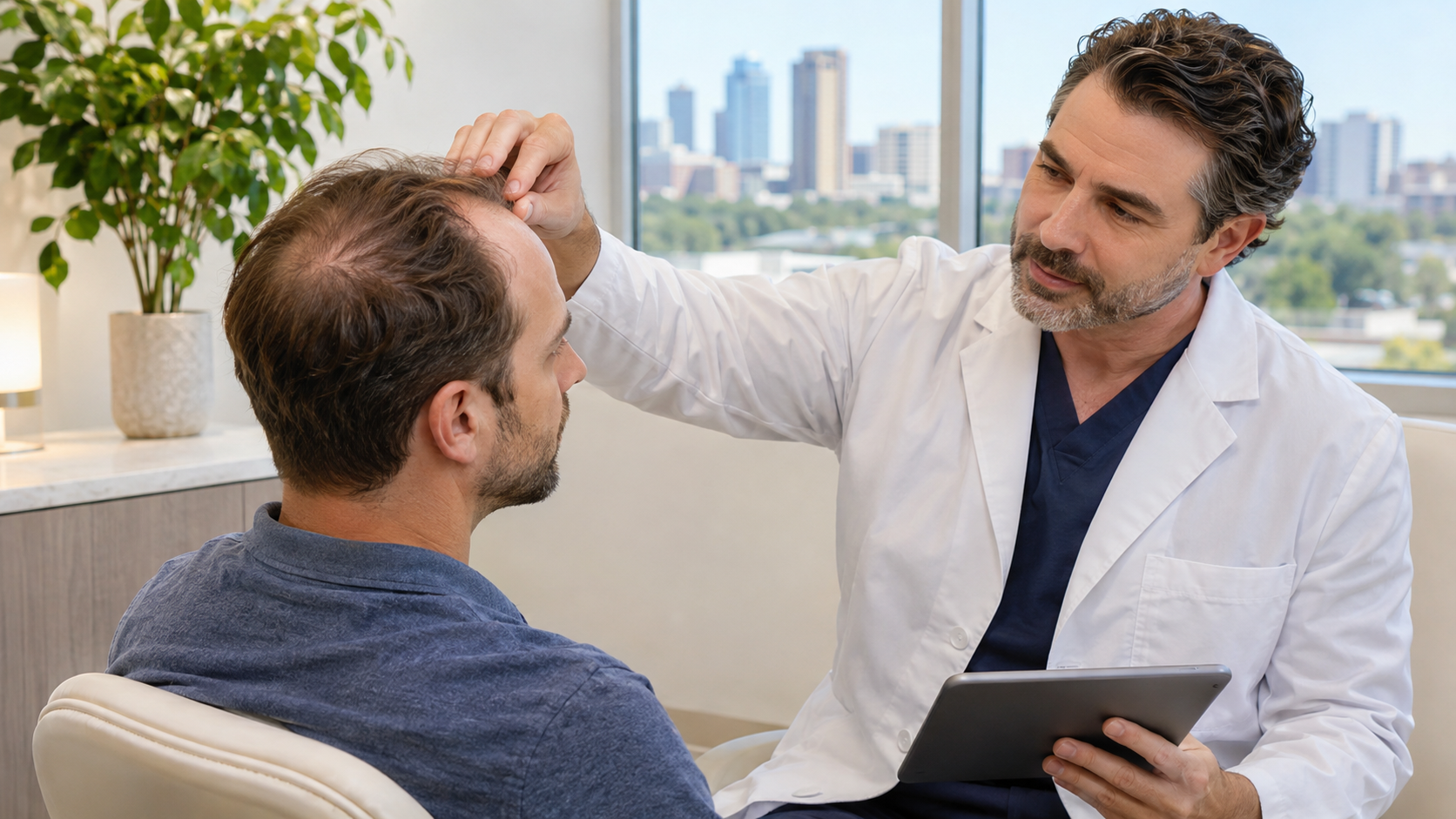
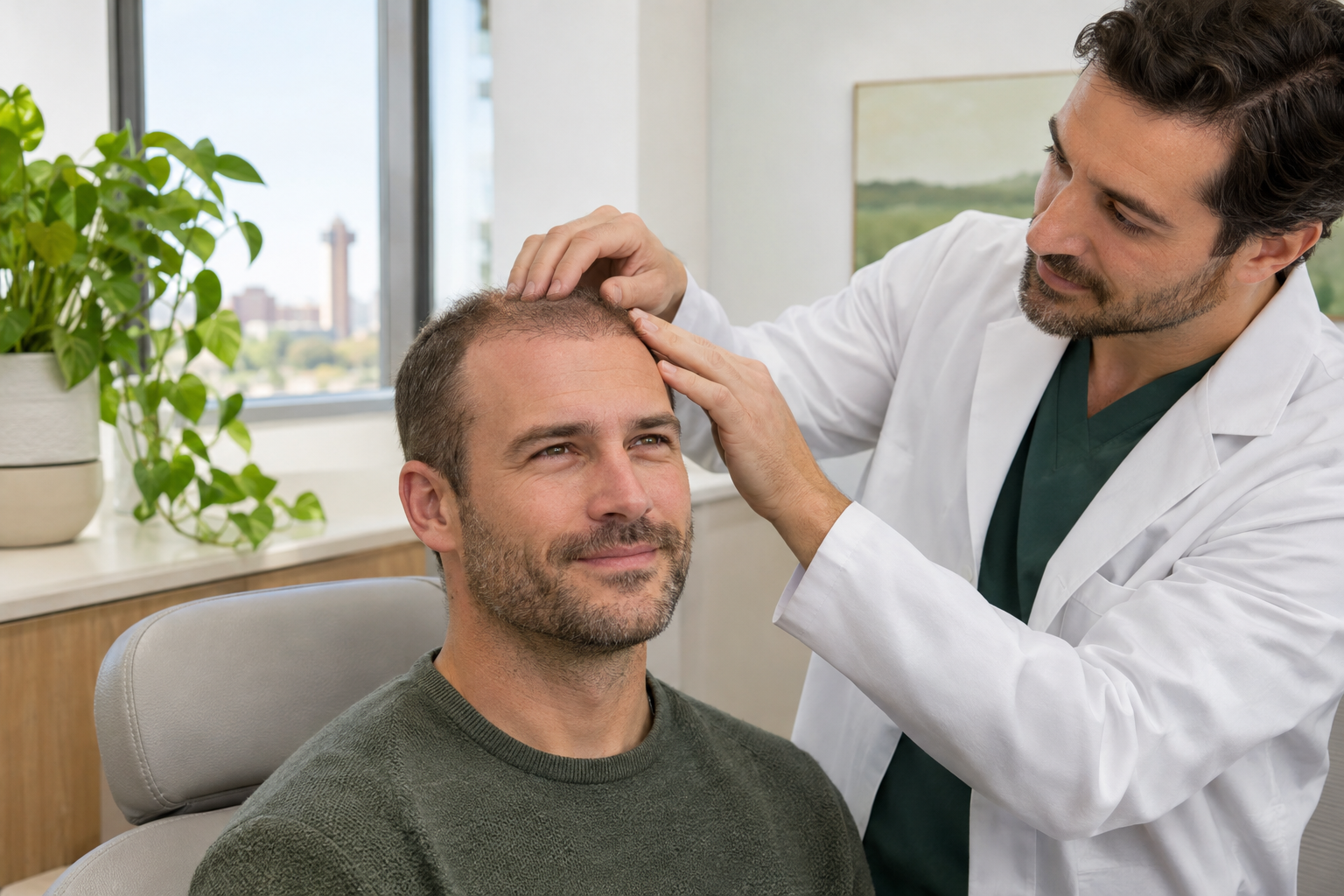
Hair Transplant for Receding Hairline: Options and Expected Results

A hair transplant for a receding hairline can move suitable donor follicles into thinning frontal areas, but the plan should account for your diagnosis, donor supply, age, facial proportions, and the possibility of future hair loss. At our Fort Worth clinic, we begin with an individualized assessment rather than assuming that surgery is the right option for every person.

A transplant redistributes existing follicles; it does not create new ones or stop untreated hair loss elsewhere. Our goal is to help you understand what may be achievable, how follicular unit extraction (FUE) and follicular unit transplantation (FUT) differ, and why a durable hairline usually requires conservative long-term planning.

Why Hairlines Recede

A receding hairline is often associated with androgenetic alopecia, also called pattern hair loss. In men, it may begin at the temples and gradually create an M-shaped pattern. Women can also experience frontal or temporal thinning, although the pattern and possible causes may differ. Genetics, age, hormonal factors, traction, scarring conditions, medications, and other medical issues can influence hair loss.

Because different conditions require different care, we evaluate the pattern and stability of your loss before discussing surgery. Sudden shedding, scalp inflammation, patchy loss, or other new symptoms may warrant medical evaluation. Our overview of male pattern baldness and its treatment options explains one common cause of a receding hairline.

How a Hairline Transplant Works

Hair transplantation moves follicular units, which are natural groups of one or more hairs, from a suitable donor area to planned recipient sites along the frontal scalp. The surgeon creates small recipient openings that guide each graft’s location, angle, and direction. Fine single-hair grafts are commonly useful at the leading edge, while grafts with more hairs may add visual density farther behind it when appropriate.

Hairline Design Is a Long-Term Decision

A low, straight hairline may use more grafts and may not remain proportionate if native hair continues to thin. We consider facial features, current loss, anticipated progression, hair caliber, donor density, and your preferences. A natural design often includes subtle irregularity and a transition from finer hairs at the front to greater density behind them. No design can guarantee a particular density or future appearance.

Donor Hair Is Limited

The back and sides of the scalp are commonly assessed as donor areas, but usable supply varies. We examine density, hair characteristics, scalp health, prior procedures, and the amount of coverage you want. Spending too much donor hair on an aggressive frontal design can limit options later, so graft allocation matters as much as the immediate hairline shape.

FUE and FUT Options for a Receding Hairline

FUE and FUT differ mainly in how grafts are harvested. Both can supply follicular units for frontal restoration, and neither method is automatically best for everyone.

FUE Harvesting

With FUE, follicular units are removed individually with small punches. This avoids a single linear donor scar, but it can leave many small round scars and may reduce donor density across the harvested zone. FUE may suit people who prefer shorter hairstyles or need a relatively focused number of grafts, depending on their donor characteristics and treatment plan.

FUT Strip Harvesting

With FUT, the surgeon removes a narrow strip of donor scalp, closes the area, and separates the tissue into follicular-unit grafts. FUT produces a linear donor scar, which is often covered by surrounding hair but may be visible with very short styles. It can be considered when a larger graft session or preservation of unharvested donor zones is important.

During consultation, we discuss scar patterns, hairstyle preferences, prior surgery, graft needs, recovery considerations, and long-term donor management. The extraction method is only one part of the outcome; diagnosis, planning, graft handling, placement, healing, and ongoing loss of native hair also matter.

Who May Be a Candidate?

A person with a receding hairline may be considered for transplantation when the cause of hair loss is understood, the donor area can provide appropriate grafts, expectations are realistic, and general health supports an elective procedure. Candidacy may be less straightforward when loss is rapidly progressing, the donor area is weak or diffuse, a scarring condition is active, or the desired hairline would demand more grafts than can be used responsibly.

  • Hair-loss diagnosis and stability: We look for a pattern that can be planned for over time.
  • Donor characteristics: Density, caliber, curl, color contrast, and scalp condition influence coverage.
  • Age and future loss: Younger patients may have an evolving pattern that is harder to predict.
  • Medical history: Health conditions, medications, smoking, and prior scalp procedures may affect planning or healing.
  • Goals: We compare the requested position and density with the available donor supply.

What Results Can Reasonably Look Like

A well-planned hairline transplant may add coverage at the temples and frontal scalp and create a softer frame for the face. Expected density varies. Transplanted follicles need adequate blood supply, and the visual result depends on the number and quality of viable grafts, the size of the treatment area, hair characteristics, placement, healing, and continued loss of non-transplanted hair.

Results are not immediate. Short transplanted hairs commonly shed during the early healing period, while the follicles remain in the scalp. New growth then develops gradually. Early change may become noticeable over several months, with maturation continuing for about a year or sometimes longer. Individual timelines vary, so our week-by-week hair transplant recovery timeline should be read as general guidance rather than a promise.

Recovery and Aftercare

After surgery, redness, swelling, tenderness, crusting, numbness, or itching can occur in the donor or recipient areas. FUE and FUT have different donor-site care needs, and FUT also involves a closed linear incision. We provide instructions based on the procedure performed, including how to clean the scalp, protect grafts, manage activity, and attend follow-up visits.

Contact the treating clinical team promptly for symptoms such as worsening pain, heavy bleeding, spreading redness, drainage, fever, or another unexpected concern. General online information cannot replace your surgeon’s instructions or an in-person evaluation.

Risks and Limitations to Consider

Hair transplantation is surgery. Potential concerns include bleeding, infection, swelling, altered sensation, visible scarring, poor growth, folliculitis, temporary shedding of nearby hair, uneven density, an unnatural design, or the need for additional treatment. Native hair can continue to recede behind transplanted areas, which is one reason a conservative design and a broader hair-loss plan matter.

Some patients may be advised to discuss medical or nonsurgical management for ongoing pattern loss. Suitability, benefits, risks, and alternatives should be reviewed with a qualified clinician who knows your health history. No clinic can guarantee graft survival, a specific density, or that one procedure will meet every future need.

What We Assess During a Fort Worth Consultation

At The Hair Transplant Center – Fort Worth, our consultation process is designed to clarify options, not pressure you into a procedure. We review the history and progression of your recession, examine the frontal scalp and donor areas, discuss prior treatments, and ask about your preferred hairline and hairstyle. We can then explain whether FUE, FUT, another approach, or continued observation may be reasonable to consider.

Useful questions to bring include:

  • What is the likely cause of my receding hairline?
  • Is my loss stable enough to plan surgery?
  • How would you choose a hairline position for my face and future loss?
  • How many grafts might the proposed area require, and how was that estimate made?
  • What donor scars and recovery should I expect with each method?
  • What could happen to the native hair behind the transplant?
  • What risks or limitations are most relevant to me?

Frequently Asked Questions

Can a hair transplant stop my hairline from receding?

No. Transplantation relocates selected follicles but does not itself stop loss in non-transplanted hair. A clinician may discuss monitoring or other management based on the diagnosis and your health history.

Is FUE always better for a receding hairline?

No. FUE avoids a linear donor scar, while FUT uses strip harvesting and leaves a linear scar. Graft needs, donor features, hairstyle, prior surgery, recovery priorities, and future planning all affect the choice.

How low can my new hairline be?

That depends on facial proportions, existing hair, future-loss risk, and donor supply. We generally favor a design that can age naturally and conserve grafts rather than automatically recreating a teenage hairline.

Will the result be permanent?

Transplanted follicles are selected from donor areas expected to be relatively resistant to pattern loss, but survival and growth cannot be guaranteed. Non-transplanted hair may continue to thin, and some people consider additional treatment later.

Discuss Your Hairline Restoration Options With Us

If you are considering a hair transplant for a receding hairline in Fort Worth, we can evaluate your pattern, donor area, goals, and medical history and explain the available options. Request a consultation with our team for an individualized assessment and a discussion of realistic expectations.

This article is for general education and is not a diagnosis or a substitute for personalized medical advice.

Hair Transplant Recovery Timeline: What to Expect Week by Week

A hair transplant recovery timeline usually includes several days of visible healing, a shedding phase during the first two months, early regrowth after a few months, and gradual maturation over roughly a year. At our Fort Worth clinic, we explain that recovery is not one identical schedule for every patient. Your procedure type, graft count, donor area, scalp characteristics, medical history, and individual healing response all influence what you experience.

This week-by-week guide can help you understand the usual stages, but it does not replace the instructions we give you after surgery. Washing methods, medications, sleep position, exercise, sun exposure, hats, haircuts, and return-to-work timing can differ between patients and surgeons. Always follow your own written aftercare plan and contact our clinical team if something does not seem right.

Hair Transplant Recovery at a Glance

  • First week: Tenderness, redness, swelling, crusting, and donor-area discomfort may occur while the small wounds begin healing.
  • Second week: Crusts commonly resolve, and the treated areas often become less noticeable.
  • Weeks 2-8: Many transplanted hair shafts shed. Some native hairs may also shed temporarily.
  • Months 2-4: The scalp can look similar to, or temporarily thinner than, it did before surgery. Early new growth may begin.
  • Months 5-9: More visible growth and coverage often develop.
  • Months 10-12 and beyond: Hair may continue to mature in length, caliber, texture, and overall appearance.

The American Academy of Dermatology’s hair transplant guidance notes that transplanted hairs commonly shed between two and eight weeks, that many patients see results between six and nine months, and that some need 12 months. The International Society of Hair Restoration Surgery also emphasizes that postoperative routines vary by surgeon, which is why our instructions for you should take priority over a general online calendar.

Procedure Day: Protect the Grafts and Follow Your Discharge Plan

After your procedure, our team will review how to care for the donor and recipient areas, how to use any prescribed or recommended medication, and what activities to avoid. You may leave with a dressing on the donor region, depending on the procedure and our plan for you. The recipient area may look pink or red, with tiny graft sites that are visible at close range.

Local anesthesia can leave the scalp numb for a period of time. As sensation returns, mild soreness, tightness, tingling, or sensitivity may develop. We may advise you to keep your head elevated when resting, avoid touching or rubbing the grafts, and arrange transportation because procedure-day medications can affect your ability to drive safely.

What we want you to remember on day zero

  • Do not scratch, pick, or press on the recipient area.
  • Use only the cleansing method and products we recommend.
  • Take medications only as directed and tell us about unexpected reactions.
  • Avoid alcohol, smoking, exercise, and other restricted activities for the period specified in your plan.
  • Know how to reach us if you have questions after leaving the clinic.

Day 1: The First Follow-Up Window

During the first 24 hours, the recipient sites are especially vulnerable to rubbing or accidental impact. Mild spotting, tightness, tenderness, and numbness can occur. Some patients begin to notice swelling near the forehead, which may shift downward before resolving.

We may arrange an early follow-up or provide a detailed remote check-in plan. If washing begins on day one, use only the technique we have demonstrated. Do not improvise with high water pressure, vigorous massage, ordinary styling products, or a towel rubbed across the grafts.

Days 2-3: Swelling and Tenderness May Peak

For some patients, swelling is most noticeable during this stage. Redness, small crusts, tightness, and mild discomfort may still be present. The donor area can feel different depending on how we harvested the grafts.

With follicular unit excision or extraction (FUE), individual follicular units are removed through small circular openings. The donor region may look dotted, feel tender, and develop tiny scabs. With FUT, the donor incision may feel tight and requires care around the closure. Neither technique is scar-free.

Continue the prescribed cleansing routine and protect the scalp from friction. Before wearing any hat or head covering, confirm when and what type we allow. A covering that presses or drags across fresh grafts can disrupt the recipient area.

Days 4-7: Crusts and Redness Begin to Settle

The small crusts around grafts often become more noticeable before they loosen. Redness and swelling usually start improving, although people with lighter skin tones or sensitive scalps may notice discoloration longer. Itching can occur as wounds heal, but scratching can injure the skin and grafts.

Many patients feel comfortable doing quiet desk work during this period, but visible healing, job demands, and the ability to protect the scalp affect return-to-work timing. If your work is strenuous, outdoors, dusty, hot, or requires a helmet, you may need a different plan. Ask us before resuming activities that could cause sweating, impact, contamination, or sun exposure.

Week 2: Scabs Resolve and the Scalp Looks More Normal

By the end of the second week, many small crusts have flaked away and the transplanted area is less obvious. The International Society of Hair Restoration Surgery describes FUE scabs as commonly resolving within about one to two weeks, while noting that individual surgeons use different care protocols.

Do not force crusts off ahead of our schedule. If buildup remains, we can advise whether the cleansing technique should change. After FUT, sutures or staples may still need evaluation or removal according to the closure method and our instructions. The linear donor incision should not be stretched or stressed prematurely.

At this point, some transplanted hairs may already begin shedding. That can feel discouraging, but loss of the visible hair shaft does not automatically mean the follicle is gone.

Weeks 3-4: Shedding Is Expected

During weeks three and four, transplanted hairs commonly enter a resting stage and shed. The recipient area can look similar to its preoperative appearance. Some nearby native hairs may also shed after the physical stress of surgery, a temporary response often called shock loss or telogen effluvium.

Shedding varies widely. You may lose many visible transplanted hairs, only some, or notice the change gradually. We encourage you to judge progress with standardized photographs and scheduled follow-ups rather than daily mirror checks.

Weeks 5-8: The Quiet or Resting Phase

By one to two months, the surface of the scalp may look healed even though the follicles remain in a biologic resting phase. The American Academy of Dermatology reports that shedding between two and eight weeks is normal and that the hair can appear thinner by the third month.

This phase is usually more about patience than visible change. Continue any scalp care or hair-loss management that we have approved. Do not begin, stop, or change prescription treatment solely because of a generic online timeline; medication decisions should reflect your diagnosis, medical history, and our clinical guidance.

Months 2-3: Early Sprouts May Appear

Some patients notice fine, colorless, uneven, or slow-growing hairs during the second or third month. Others see little visible change yet. Early hairs may not resemble the final result because they can be thin and immature.

Temporary pimples or small cyst-like bumps can sometimes appear as hairs begin emerging. Do not squeeze or pick them. Contact us so we can determine whether simple care is appropriate or whether the area needs an examination.

Month 4: Growth Becomes Easier to Track

By month four, more new hairs may become visible, but density is still developing. Growth can be uneven across the scalp, and different treatment areas may mature at different speeds. Hairline, mid-scalp, and crown restoration do not always look complete on the same schedule.

Our team uses follow-up photographs to compare consistent angles, lighting, hair length, and styling. This provides a fairer assessment than comparing one close-up image with a differently lit photograph.

Months 5-6: Noticeable Growth Often Begins

Many patients see a more meaningful change by months five or six. New hairs may still be fine, short, and variable in texture. The appearance can continue improving as more follicles grow and individual shafts become thicker.

If your procedure used follicular unit transplantation (FUT), we will also monitor the linear donor scar and discuss appropriate scar care. FUT removes a donor strip that is divided into follicular-unit grafts. FUE harvests individual units and leaves many small circular scars instead. The recipient-area growth cycle is similar because both techniques ultimately place follicular-unit grafts into thinning areas.

Months 7-9: Increasing Coverage and Maturation

Between months seven and nine, growth is often easier to see in everyday lighting and photographs. Hair length increases, more shafts may emerge, and coverage can improve. According to the American Academy of Dermatology, many patients see results during this interval.

Results remain individual. Donor-hair characteristics, graft survival, treatment area, scalp-to-hair color contrast, curl, caliber, continued loss of native hair, and styling all influence the visual effect. We avoid promising a specific density or identical timeline for every patient.

Months 10-12: A More Complete Result Takes Shape

By about one year, many patients can make a more meaningful assessment of the transplant. Hair may continue to thicken, soften, lengthen, and settle into its natural direction. Some areas, especially the crown, may mature more slowly.

A one-year review can help us assess growth, the donor area, the surrounding native hair, and whether any future treatment should be considered. Continued thinning outside the transplanted area can change the overall appearance even when transplanted follicles are growing.

Beyond 12 Months: Long-Term Follow-Up

Some improvement can continue beyond the first year. Long-term planning may include monitoring native-hair loss, discussing medically appropriate maintenance, and preserving donor supply. A second procedure is not automatically necessary and should be based on remaining donor hair, evolving loss, scalp health, and realistic goals.

You can review information about Dr. Stefan P. Thiele and our hair-restoration approach as you consider who will guide your procedure and follow-up care.

FUE vs. FUT Recovery: What Is Different?

Recovery factorFUEFUT
Donor woundsMany small circular extraction sitesOne linear donor incision closed with sutures or staples
ScarringSmall distributed scars; not scar-freeLinear scar that may be concealed by surrounding hair
Early discomfortOften described as less uncomfortable, but experiences varyDonor tightness and incision tenderness may be more noticeable
Donor aftercareCare for multiple small extraction sitesProtect the closure and follow removal instructions if applicable
Recipient growthBoth methods place grafts in recipient sites, so shedding and gradual regrowth follow broadly similar biologic stages.

The technique that fits you depends on donor characteristics, graft needs, prior surgery, hairstyle preferences, scarring considerations, medical history, and long-term goals. We do not present either method as universally better.

When to Contact Our Clinical Team

We want you to contact us whenever you are unsure about your recovery. Seek prompt medical advice for symptoms such as:

  • Bleeding that is heavy, persistent, or not controlled as instructed
  • Severe or worsening pain rather than gradual improvement
  • Fever, chills, pus, foul drainage, or spreading redness
  • Rapidly increasing swelling, breathing difficulty, hives, or signs of an allergic reaction
  • Wound separation or a problem with FUT sutures or staples
  • Darkening skin, concerning tissue changes, or trauma to the grafts
  • Any symptom that feels urgent or substantially different from the plan we discussed

If you believe you are experiencing a medical emergency, seek emergency care rather than waiting for an online reply.

Frequently Asked Questions

How long should I take off work after a hair transplant?

Time away depends on visible healing, your comfort, procedure type, and job demands. Quiet desk work may be possible sooner than strenuous, outdoor, dusty, hot, or helmeted work. We will give you an individualized recommendation.

When can I wash my hair normally?

We will show you how and when to clean the donor and recipient areas. Early washing is usually gentle and avoids rubbing or strong water pressure. Do not switch to your normal routine until we tell you the grafts and wounds are ready.

Is shedding after a hair transplant normal?

Yes. Many transplanted hair shafts shed between two and eight weeks. Nearby native hairs can also shed temporarily. Contact us if shedding is accompanied by inflammation, severe symptoms, or another concern.

When will I see my final hair transplant results?

Many patients notice visible growth between six and nine months, while fuller maturation may take 12 months or longer. Treatment area and individual healing affect the timeline.

Can I speed up hair transplant recovery?

There is no responsible shortcut. Protect the grafts, follow our cleansing and activity instructions, take only approved medications, attend follow-ups, avoid tobacco, and give the follicles time to cycle naturally.

Plan Your Recovery With Our Fort Worth Team

A successful recovery is built on realistic expectations, careful aftercare, and easy access to the team managing your procedure. Before surgery, we review the technique, donor and recipient care, time away from normal activities, likely shedding, growth milestones, potential complications, and how to reach us with questions.

If you are considering treatment in Fort Worth or elsewhere in North Texas, request a hair transplant consultation with our team. We can evaluate your hair-loss pattern and donor area, discuss FUE and FUT, and explain the recovery plan that would apply to your circumstances.

This article provides general education and does not replace your surgeon’s instructions, diagnosis, or individualized medical advice.

Skip to content